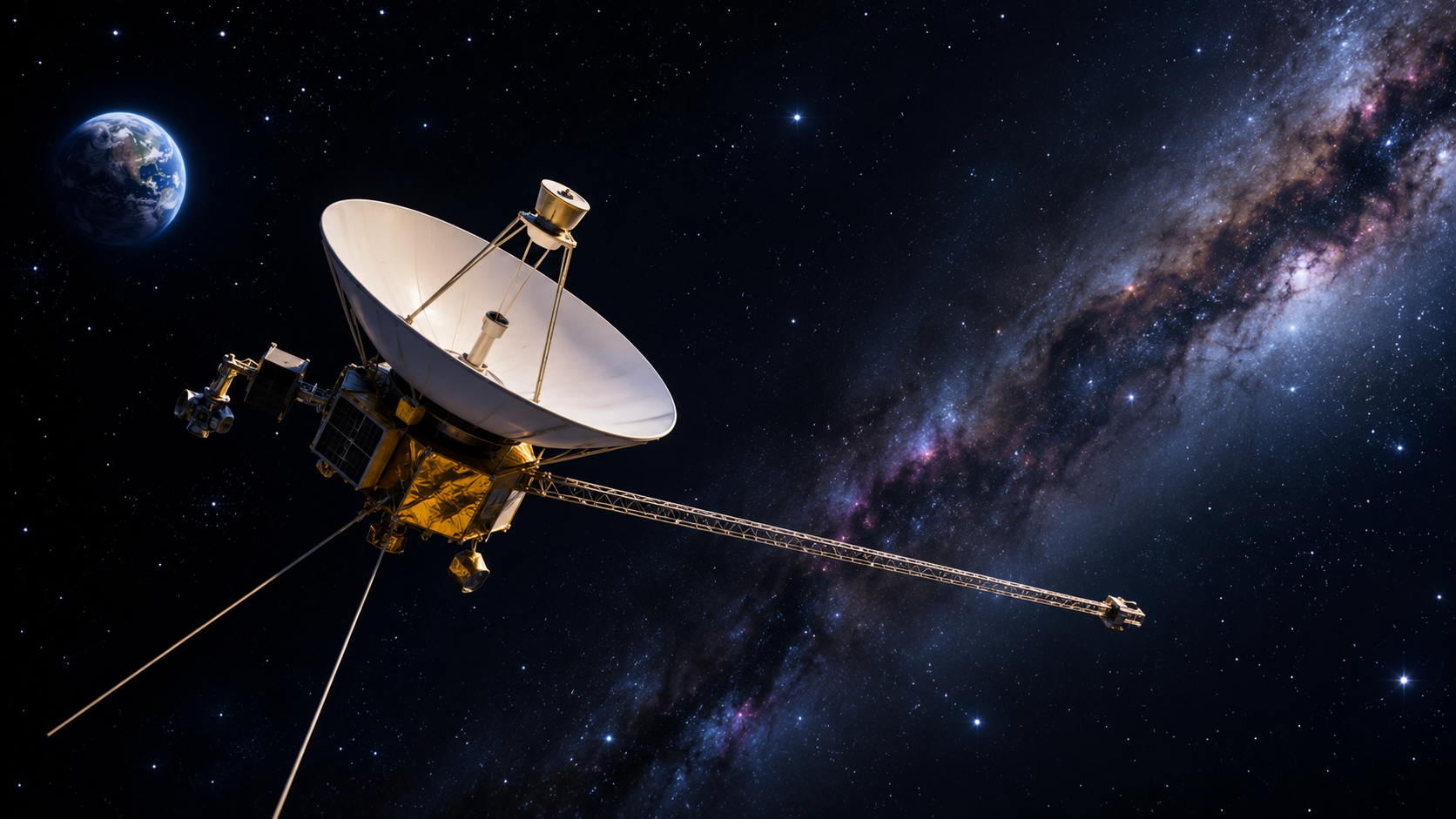

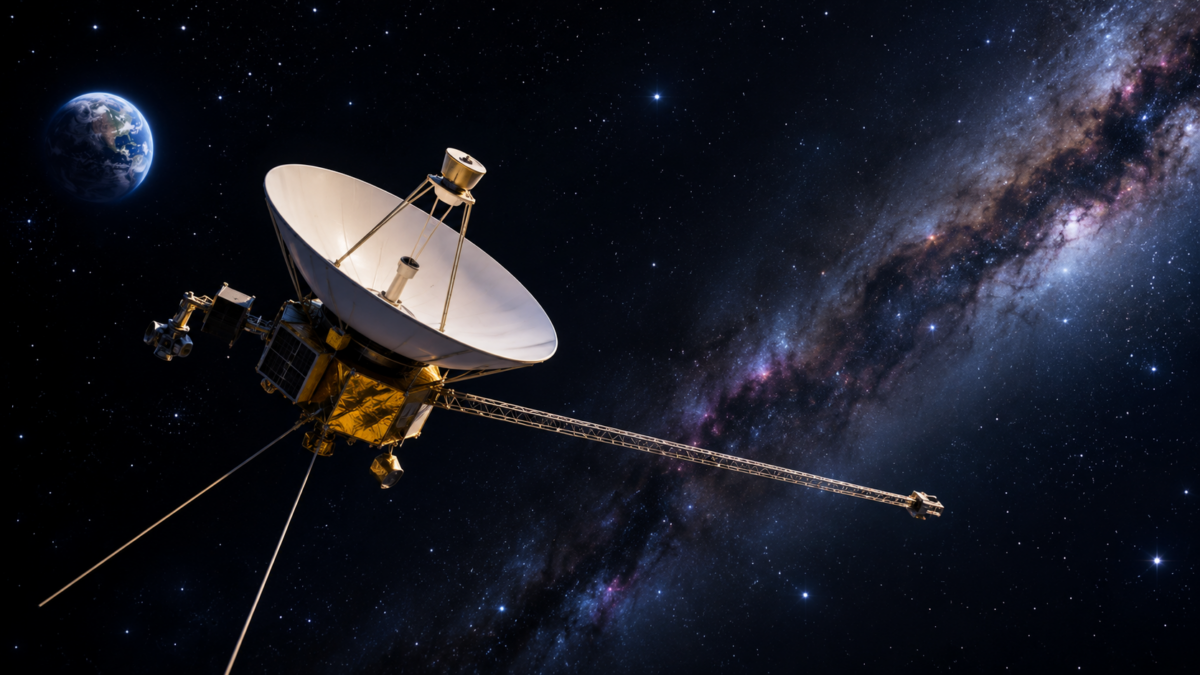

NASA’s Voyager 1 spacecraft is preparing to achieve another historic milestone as it approaches a distance of one light-day from Earth. The spacecraft is expected to reach this unprecedented distance on Wednesday, November 18, 2026, becoming the first human-made object to travel so far from our planet.
According to NASA, Voyager 1 will be approximately 16.094 billion miles (25.902 billion kilometers) away from Earth when it reaches the milestone at 5:16 a.m. Eastern Standard Time. A light-day represents the distance light travels in 24 hours, making the achievement a remarkable demonstration of how far humanity’s most distant spacecraft has traveled.
The milestone also highlights the growing communication delay between Earth and the spacecraft. Because radio signals travel at the speed of light, a command sent from Earth will take approximately 24 hours to reach Voyager 1. Any response from the spacecraft will require another 24 hours to return. This means engineers must wait nearly two days to complete a basic communication exchange.
Launched on September 5, 1977, Voyager 1 was originally designed to explore the outer planets of our solar system. During its journey, the spacecraft conducted historic encounters with Jupiter in 1979 and Saturn in 1980, sending back valuable scientific observations and images. It later continued toward interstellar space, becoming the first human-made spacecraft to cross the heliopause in August 2012.
Voyager 1 is currently traveling through interstellar space at approximately 38,000 miles per hour (61,000 kilometers per hour). Despite being nearly 50 years old, the spacecraft continues to operate and collect scientific information about the environment beyond the Sun’s protective bubble of particles and magnetic fields.
However, keeping the aging spacecraft operational has become increasingly challenging. Voyager 1 relies on radioisotope thermoelectric generators powered by the heat produced as plutonium decays. The available electrical power decreases by approximately four watts each year, forcing NASA engineers to carefully manage its remaining energy.
In September 2026, engineers completed an important power-saving operation called the Big Bang, switching off three devices and replacing them with lower-power alternatives. The changes are expected to help keep Voyager 1’s remaining scientific instruments operating for longer than previously anticipated.
The spacecraft also experienced a brief communications interruption in October. NASA‘s Deep Space Network failed to detect its radio signal during two scheduled communication attempts on October 18 and 19. Contact was restored on October 20, and NASA engineers have maintained communication with the spacecraft since then. The team is still investigating what caused the unexpected interruption.
Voyager 1 is not alone on its journey. Its twin spacecraft, Voyager 2, was launched on August 20, 1977, and followed a different route through the outer solar system, visiting Uranus and Neptune. Voyager 2 entered interstellar space in 2018 and is expected to reach the one-light-day distance from Earth in November 2035.
Both spacecraft also carry the famous Golden Record, a gold-plated copper disc containing sounds, images, music and greetings in 55 languages. The record was designed to represent life and human civilization on Earth in case the spacecraft are ever discovered by intelligent life elsewhere in the universe.
To celebrate Voyager 1’s upcoming achievement, NASA is inviting people around the world to participate in an event called “Shine Bright for Voyager’s Light-Day.” On November 17, after sunset, participants are encouraged to use flashlights, mobile phones and other lights to create a symbolic wave of light while flashing the letters V-G-R in Morse code, representing Voyager’s call sign.
NASA will also host a special discussion with members of the Voyager mission team on November 19 to discuss the spacecraft’s condition, scientific discoveries and the engineering challenges involved in keeping the nearly five-decade-old probes operational.
The upcoming one-light-day milestone will not change Voyager 1’s operation or its surrounding environment. Instead, it represents another extraordinary achievement for a spacecraft that has continued exploring the universe long after its original planetary mission ended.
If this article helped you, please consider supporting our work. Every small contribution keeps Abijita.com independent and running.